It’s probably the question I’ve been been asked more than any other throughout my career.
«Laura, what should I eat?»
People usually expect a simple answer. A shopping list. Foods to buy, foods to avoid, the latest superfood, the newest trend or perhaps the perfect balance of protein, carbohydrates and fats. I understand why. Nutrition has become incredibly confusing. Every week another expert appears with another list of foods we should fear or embrace. Eggs were once considered dangerous, then they became a superfood. Fat was blamed for decades, then carbohydrates took its place. Salt became the villain, then sugar, then gluten, then seed oils. With so many contradictory messages, it’s hardly surprising that people feel lost.
The problem is that, after more than thirty years studying the human body, I’ve come to believe that this isn’t the right question at all. If health depended on a shopping list, we would have solved obesity, chronic fatigue, digestive disorders and metabolic disease decades ago. Choosing the «right» foods is important, of course, but before asking what to eat, there is another question that deserves our attention.
What does the human body actually need in order to thrive?
To answer that question, we have to travel back in time. Not fifty years or even one hundred, but hundreds of thousands of years, long before supermarkets, calorie-counting apps, nutrition labels and home deliveries. Imagine waking up as one of our ancestors. There was no fridge waiting to be opened, cereal cupboard, coffee machine and certainly no convenience store around the corner. If you wanted breakfast, you first had to move. You walked for miles, climbed hills, searched for berries, roots, eggs, shellfish or fish and, on some days, you found very little at all. Food wasn’t guaranteed; it was seasonal, local, unprocessed and entirely dependent on the environment.
The human body evolved under those conditions for hundreds of thousands of years. Eating was only one part of a much larger rhythm that included movement, daylight, rest, recovery and periods when no food was available. Digestion had time to finish its work before the next meal arrived, sleep followed the setting of the sun and the body continuously adapted to the changing seasons. Life wasn’t easier, but biology developed within a remarkably consistent environment. We were synchronised and connected with the environment, a much healthier one that the one we now live in.
Let’s compare the two.
Today, food is available almost everywhere, at every hour of the day. We eat while driving, working, answering emails, watching television and sometimes simply because food happens to be within reach. Supermarkets offer tens of thousands of products, many of them designed to be irresistibly tasty, incredibly convenient and difficult to stop eating.
Never before has humanity had such easy access to calories, yet never before have we been so confused about nutrition.
Perhaps the greatest change isn’t what we eat, but the environment in which we eat.
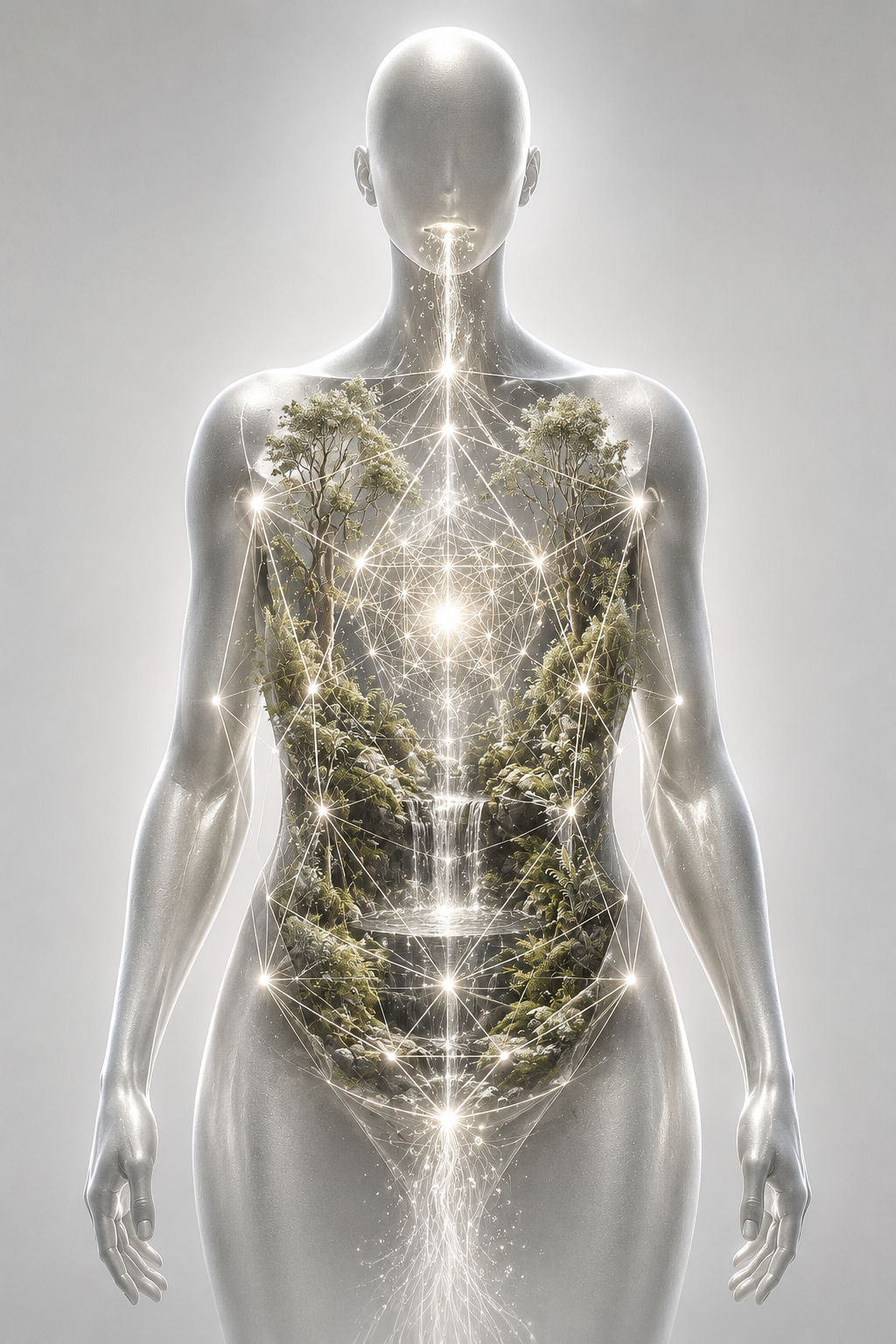
Your body isn’t a machine into which food is poured. It is a living biosphere, an extraordinarily sophisticated ecosystem made up of trillions of cells that communicate continuously while performing an unimaginable number of biological processes every second. Your heart beats, your lungs exchange gases, hormones are produced, enzymes are released, damaged tissues are repaired, old cells are recycled, new ones are created and your immune system quietly patrols the body, all without asking for your permission or your attention.
Healthy biology is never passive; it is constantly adapting, regulating and responding to the world around you.
Every single one of us is like a biosphere, one that depends entirely on the quality of its environment.
Imagine buying the most exotic plants in the world for your garden. If the soil is exhausted, the water polluted and the sunlight insufficient, those plants will never reach their full potential, no matter how expensive they were. A skillful gardener won’t force a plant to grow rather improve the conditions that allow healthy and resilient growth to happen naturally.
The human body deserves exactly the same approach.
Before asking it to produce more energy, balance hormones, improve digestion, sharpen concentration or repair damaged tissues, perhaps we should first ask whether we’ve created the conditions that allow those things to happen.
That, to me, is the true meaning of bio-nutrition.
It isn’t another diet or another collection of food rules. It is the understanding that every biological process depends on the environment in which it takes place.
Food is only one part of that environment, although it is an extraordinarily important one. Every mouthful begins an incredible journey. It has to be broken down by the digestive system, absorbed through the intestine, transported throughout the body and transformed into energy, hormones, enzymes, neurotransmitters, muscles, bones, skin and every other structure that keeps us alive. At the same time, everything the body no longer needs must be recycled or eliminated efficiently. Nourishment and elimination are not separate events; they are two halves of the same biological process.
This is one of the reasons I find the question «What should I eat?» so incomplete.
A far more interesting question is whether your body can actually use the food you eat.
Can you digest it comfortably? Can you absorb its nutrients efficiently? Can your cells transform those nutrients into energy? Can your body eliminate what no longer serves a purpose? If any of those stages begin to fail, the quality of the food alone is no longer enough.
One of the things that surprises me most is how many people have stopped expecting digestion to feel effortless. Bloating, reflux, constipation, feeling heavy after meals, relying on something sweet for energy or accepting discomfort after eating have become so common that many people assume they are simply part of modern life. They aren’t. They are common, but common and normal are not the same thing.
A healthy digestive system should work quietly in the background. You should eat, digest, absorb, eliminate and move on with your day without giving it a second thought. When digestion begins to struggle, however, the consequences extend far beyond the stomach. Energy changes, concentration changes, sleep changes, mood changes and, gradually, the entire organism has to adapt to an environment that is no longer supporting it as efficiently as it could.
Perhaps this is also where we’ve misunderstood metabolism. Today, people speak about having a «fast» or a «slow» metabolism, usually in relation to body weight. Biology doesn’t think in those terms. Simply put, because this is a topic in itself, a healthy metabolism isn’t one that is permanently fast; it is one that adapts continuously to the body’s needs, using nutrients efficiently, producing abundant energy, repairing tissues when necessary and avoiding unnecessary waste. Nature has always favoured efficiency over excess.
Think of a beautifully engineered engine. The best engine isn’t the one that burns the most fuel. It’s the one that travels further, climbs hills effortlessly, responds instantly when more power is required and does all of it using only the fuel it genuinely needs. Human biology works in much the same way. The goal isn’t to be able to eat as much as possible; it is to nourish the body so efficiently that every cell has what it needs to perform, repair and renew itself with the right amount (minimum) of consumption.
So, what should you eat?
Start with food your grandparents would recognise. Choose ingredients more often than products, eat with rhythmrather than continuously, allow your digestive system to finish one job before asking it to begin another, observe how your body responds and remember that no one knows your biology better than your own biology itself.
The perfect diet doesn’t exist because no two human beings are identical. Healthy biology, however, follows remarkably consistent principles.
What I can tell you for sure is that, when we provide real food, respect natural rhythms and create the conditions in which digestion, absorption, metabolism and elimination can work together, the body begins to do what it has always been designed to do: regulate itself, repair itself, adapt to its environment and renew itself, quietly and brilliantly, every single day.
Perhaps the question was never simply, «What should I eat?»
Perhaps the better question has always been:
«What does my biology need in order to thrive?»